It takes an intricate mix of boxes, brooms, chairs and blankets to create a proper castle. This is from my just released Ready to Play! written by Stacey Kaye, illustrated by Yours Truly, Free Spirit Publishers. (Click the cover to learn more.)
Wowsa. Well, I'm home from our 2009 SCBWI Springmingle conference and the snow is finally melting . . . in GEORGIA!! Gads. I hope our wonderful (out of town) speakers finally made it home safely too. They were: Abigail Samoun of Tricycle Press; Mary Kate Castellani of Walker; Caitlyn Dlouhy of Atheneum; and Kathleen Duey (biggie author!). Of course the weather completely messed with their travel plans. The bonus was I got to spend more time with all of them as we hung out for two extra days at Little Shop of Stories, the King Tut exhibit and Mary Mac's Tea Room (they adored the fried green tomatoes and banana puddin'). Truly, Atlanta doesn't get snow very often, so perhaps they felt lucky to get stuck here? Maybe... It was my great pleasure to be Caitlyn's angel all weekend, which basically meant I was glued to her hip to help her with anything she needed during the conference. Because I was always around I can honestly report Caitlyn is one of the most generous editors we've ever hosted. She made a point of meeting everybody and answering all the questions that came her way, spending real time with every single person. We got along fantastically well too (not hard). What a nice, nice person and incredibly talented editor! We leaned on our local talent as well. Shelli Johannes Wells, creator of Market My Words, talked about marketing (very educational); and Daniel Powers and Liz Conrad both gave talks about illustration. I wasn't able to make it to Daniel's talk but learned a ton from my good friend Liz. As usual our incredible RA's, Jo Kittinger, Donna Bowman, Heather Montgomery, and Robyn Hood Black (and the husbands) did an amazing job of pulling together a spectacular event and making it look easy (it wasn't, trust me!). We are so incredibly lucky to have them and such a dedicated group of volunteers in our region - we've truly created a tour de force which (I have straight from the source) is gaining widespread attention in the publishing world. I was also thrilled to be presented with my Magazine Merit Award during Saturday's dinner. Of course I didn't take any pictures, but Sarah C. Campbell took some beauties. (I'll post more as I find them.) If you can ever make it to one of our regional events, I highly recommend them. The atmosphere is much more intimate than at national events and you get the chance to really talk to editors and your peers and learn new information. Hope to see you next year!
If you ever doubt that books for "children" can change lives - give a listen to this poem by Laurie as a follow up to all the letters she's received in response to her 10-year-old classic, Speak.
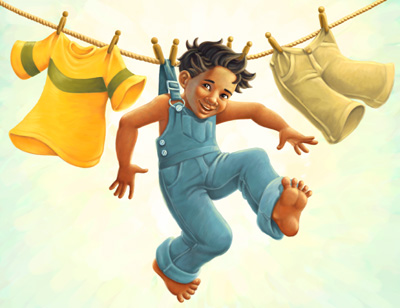
Well, when you get hung out to dry, you gotta hope for a nice breeze! This is from the back cover of Soap, soap, soap ~ Jabón, jabón, jabón, my first book as illustrator/author which will come out this Fall!
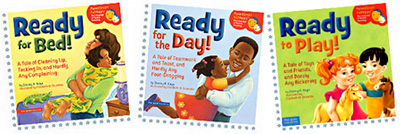
The latest edition of "e's news" went out yesterday and it's chocked full of cool info. You can read it in it's entirety here. Want your own copy when it comes out? Sign up at "e's news." Here's the biggest part: BOOK NEWS! Drum roll please...The latest book in the ParentSmart KidHappy™ series is now available! It's called Ready to Play! A Tale of Toys and Friends, and Barely Any Bickering (by Stacey R. Kaye and illustrated by Yours Truly, Free Spirit Publishing). It teaches parents and their kids how to get through a play date smoothly and is a great addition to Ready for Bed! and Ready for the Day! (more news on those two below)!
It's official, my first picture book as author/illustrator, Soap, soap, soap ~ Jabón, jabón, jabón (Raven Tree Press) is out the door and will be released this Fall!! Lots more news on that one as we get closer to the release date!
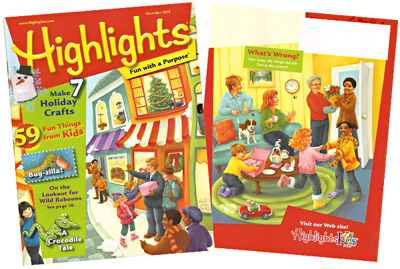
I just received my contributor copies of the March Highlights Magazine. I illustrated the story, "Finding the Robin's Nest," written by Andrea Vlahakis (page 32-3). Once again, I'm sharing the pages with lots of friends and favorite illustrators. Look for the issue, it should be on stands (or in your mailbox) soon!
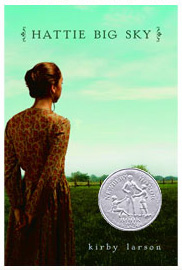
Today I have the great honor of interviewing an amazingly talented author and friend - Kirby Larson! Kirby's first novel, Hattie Big Sky was selected as a 2007 Newbery Honor Book!! Recently, she's switched gears and written a touching picture book along with fellow author, Mary Nethery (illustrated by Jean Cassels). Two Bobbies is based on a true story of survival during Hurricane Katrina and will be available this August. (Click the cover to visit its website.) I'm pleased to help drum up some excitement for this wonderful book and recently spoke with Kirby about it:
The first time I read Two Bobbies I had chills non-stop and tears in my eyes. How did you make it through writing this book!?
Well, neither of us can make it through reading it aloud, that's for sure! But I think we got to a point in the writing process where it was so important to tell the story right, in a way that honored and respected what happened, that we were able to take a step back and focus on that, rather than on the heart-breaking events.
How did you first learn about the story? And how did you know you wanted to write about it?
I'm going to answer these questions in reverse order. I like to say Mary and I have been friends for about 140 dog years; we met at a workshop taught by Jane Yolen and immediately clicked. We've been critiquing each other's work since the get-go, in addition to rooting each other on in the dark times. During one dark time, when neither of us was getting anything published, I proposed to Mary that we try writing something together. What did we have to lose? Mary was game but we spent quite a bit of time talking about how we would go about this (our friendship was paramount!) and what kind of story we'd tackle. Since we are dear friends and since we love animals, we decided to look for a story about unlikely animal friends. We went through about a dozen ideas. One night, in February 2006, after Hurricane Katrina, Mary caught a short segment on Anderson Cooper's 360 which featured Bobbie dog and Bob Cat. She called me that very second and we both knew we'd finally found "our" story. You can read more about the story behind the story at our website, www.twobobbies.com.
What was your editor's reaction to the story?
We wrote the manuscript first and then our agents shopped it around. Believe it or not, it was rejected a few times. Then it was faxed to Bloomsbury/Walker; it was intended for another editor but Emily Easton saw it. She knew the story and had been wanting to do it as a book. She's also an animal lover so the story was a nice fit, all the way around.
Have you done many public readings of Two Bobbies? What's been the reaction?
Mary and I got to do our first-ever joint reading about a week or so ago, at Third Place Books in Lake Forest Park, Washington (Mary lives in Eureka, CA and I live near Seattle so joint appearances are rare). The audience responded in an incredibly warm and generous way -- in fact, the story inspired one woman to buy a copy of the book for another young woman in the audience -- a complete stranger to her. It just shows, again, that animals have the power to help us be our best selves.
Do you have any pets? Did that affect the story in any way?
Mary has a much adored new kitten, Dash; we have an ancient kitty named Mimi. I think being animal lovers in general drew us to the story.
What's coming next? Sneak peeks?
Mary and I had so much fun writing the Bobbies together that we have partnered on another book, due out in Fall 09 from Little Brown. It tells the story of an abused dog adopted by a Marine and brought home to the states – but with an incredible twist. I am hard at work on another historical novel. It's been a real challenge to do another novel after Hattie Big Sky and I think I finally, finally have my writing legs back under me.
Thanks so much Kirby!
Thanks, Elizabeth, for interviewing me. It makes me feel as if we're sitting at the table together, over coffee -- something we need to do again and soon!
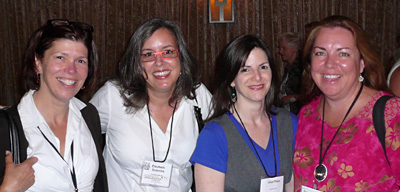
Definitely! Just gotta jump this continent between us! Here are Kirby and me with Alice Pope and Roxyanne Young at the 2007 SCBWI National Conference in LA:
Thanks again to Kirby Larson for appearing, courtesy of Provato Marketing. For other stops on the tour please check ProvatoEvents.com.
Stories encourage dreams - reading helps kids make their dreams come true. That singular idea - that we can help kids realize their dream - is the foundation of Share a Story - Shape a Future.
Share a Story - Shape a Future is a blog event for literacy. Throughout the week, blogging librarians, teachers, parents, authors, illustrators (me!) and people passionate about literacy will offer ideas on ways to promote reading and books. You won't find statistics, academic analysis, or judgments that tell you why you should read. Instead, we are using the power of the Worldwide web to share ideas about ways to engage kids as readers.
Each day, bloggers will talk about different aspects of literacy and reading. Themes include raising readers, selecting suitable material, tips for reading aloud, using audiobooks, and how to use the library as an ally. The organizers have several giveaways planned, and will offer free, downloadable content.
Share a Story - Shape a Future is an opportunity to share ideas, encourage each other, and spread the word about children's literacy. Share a Story- Shape a Future aims to build a community of readers. Please join us and share your story.
The 2009 Share a Story event will take place March 9 to 13, 2009.
Day 1: Raising Readers hosted by Terry Doherty at Scrub-a-Dub-Tub Day 2: Selecting Reading Material hosted by Sarah Mulhern at The Reading Zone Day 3: Reading Aloud - It's Fun, It's Easy hosted by Susan Stephenson at the Book Chook Day 4: A Visit to the Library hosted by Eva Mitnick at Eva's Book Addiction Day 5: Technology and Reading - What the Future Holds hosted by Elizabeth O. Dulemba at dulemba.com (HERE! on March 13th!)
Share a Story- Shape a Future aims to build a community of readers. Please join us and share your story. Visit Share a Story - Shape a Future to learn more and see the full schedule of contributors.
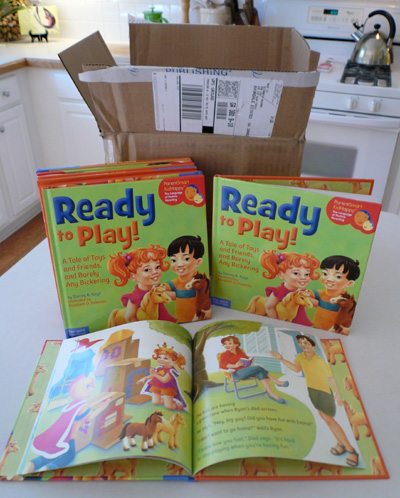
It's book delivery day at Camp Dulemba - woohoo! This is the third book in the ParentSmart KidHappy™ series written by Stacey Kaye (illustrated by Yours Truly) published by Free Spirit Publishers. The goal of this book is to get parents and their children through a play date in a sane manner - great! Interested? I'm guessing it'll be in a store near you pretty soon - groovy! And lest you think my life is all about celebrations and good thing, I have to share that my cat was so happy for me, she promptly threw up on the bed. Yup - that's life for ya. *sigh*
Learn more about the ParentSmart KidHappy™ series - click the covers!
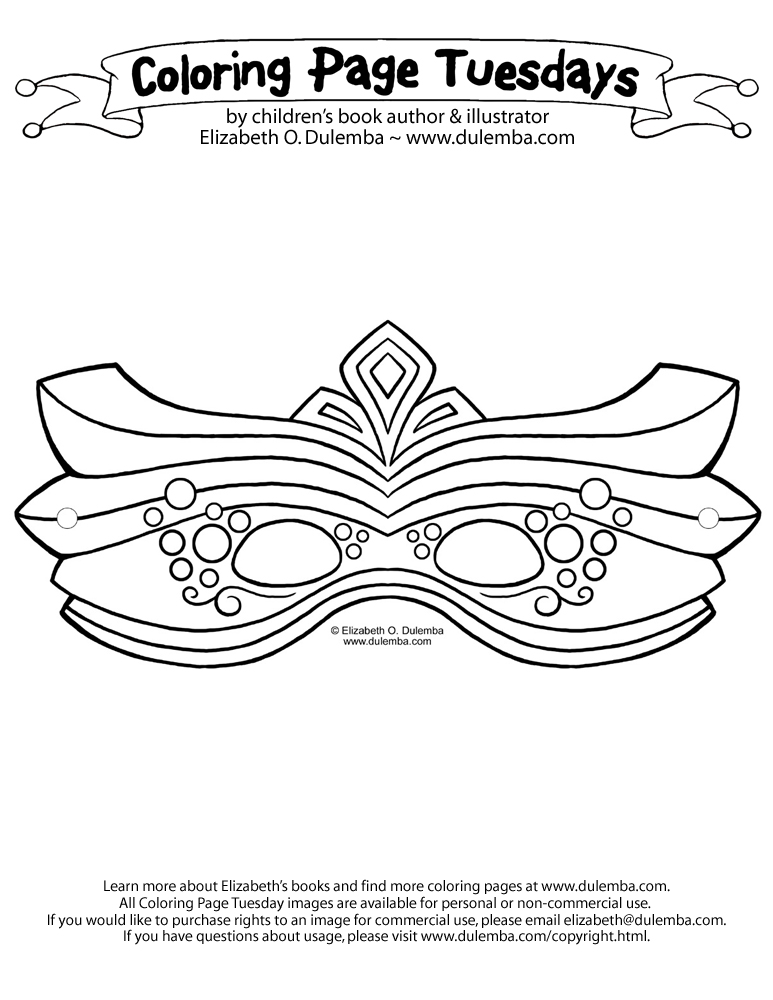
Sign up to receive alerts when a new coloring page is posted and to view more coloring pages - click here! It's Fat Tuesday! Mardi Gras! So in an effort to help you celebrate, I've created something new - a Mask! Print it, color it, cut it out (eye holes and string holes too), loop some elastic or string through the side holes and put it on your head! And this time, maybe you could send me a picture of you wearing your mask? Same as always - less than 1mb emailed to coloringpages@dulemba.com and I'll post it to my blog!
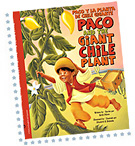
Learn about my bilingual picture book Paco and the Giant Chile Plant ~ Paco y la planta de chile gigante - click the cover.
Well, I told myself I was going to stop embedding so many videos as they tend to slow older machines down (mine for instance), but I also keep stumbling across these amazing videos (thanks to Deborah Wiles)! So, what to do? Share of course. This is Elizabeth Gilbert, author of "Eat, Pray, Love," at a recent TED conference talking about how creative people can deal with the creativity that seems to use us up. Adapting her thoughts on the matter may keep you sane (in your head anyhow), it might even add years to your life! I know I'll be thinking this way. I kind of already do. I often tell my husband, "I have a story coming in" or "A story came in last night - I have to write it down." I'm also feeling pressure to complete this dummy I'm working on, because I feel the idea is on loan. If I don't work through it fast enough, the muse may share it with somebody else. (A possible reason so many vampire novels came out at the same time.) I need to get on it. Do you feel that way too? Are you the creator, or does the creativity work through you? Watch the video and leave a comment - I'd love to hear how it works for you!
According John Shelley from my PBAA board, Sony played this video at their executive conference this year. Not sure what it all means - but it will definitely blow your mind!
What is it about boys and mud? It's like instinct just draws them to it... This is the first piece I'm showing from Soap, soap, soap ~ Jabón, jabón, jabón, my first book as author/illustrator, which will be released this Fall! I've just completed the art and it's about to head out the door - woohoo!
OMG!!! squeeeeee I just received an email from Stephen Mooser, President of the Society of Children's Book Writers and Illustrators (scbwi.org) . . . I am the "2008 recipient of the Magazine Merit Award for Illustration for my cover art for the December 2008 Highlights Magazine"!!! I'm thrilled!!! Especially considering there is nothing like receiving acknowledgment from your peers - so I have been trying to win an award from SCBWI for Years now and was convinced my window of opportunity had finally closed. AND considering this particular piece of art completely kicked my . . . bum! It was so hard to pull off, with so many changes, I truly doubted I had any skill at all by the time it went out the door. That one drew blood. So imagine my complete surprise to receive this honor! I am thrilled beyond belief!! Will you squeeeee with me (in my comments section)?
Like the new background pattern for my website? I made it this morning. We're in the thick of weird Winter-ish weather here in the south and I just needed some sunshine. Daisies always instill hope for Spring. (You'll need to visit my main site to see it if you follow me through a feed: http://dulemba.com/blogger.html.) :)
Great news for the 3rd book in the ParentSmart KidHappy™ series: READY TO PLAY! (written by Stacey Kaye, illustrated by Yours Truly, Free Spirit Publishing) was listed in Publishers Weekly's "Fall 2009 Sneak Peak Preview"! Book three, you say? Why yes, it comes out this April, and I'll do a big woohoo then, but here's my sneak peek at the cover:
Learn more about these books on proper parenting language and the power of choice - click the covers. Or listen to author, Stacey Kaye, talk about the concepts behind the books on Sandy Springs Radio's Book Talk with Gail Cohn (the 02/09 broadcast). I may be biased because Stacey is also a friend, oh, and because I illustrated them, but these really are amazing books for new parents. Heck, I learned a few things myself. Off to work on book four!...


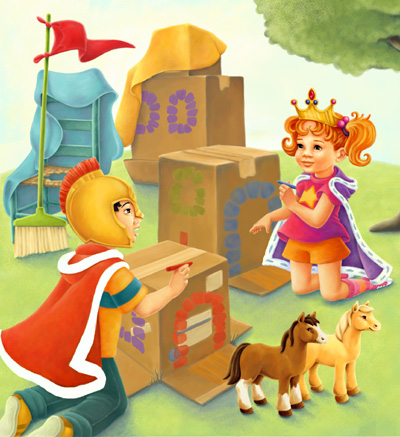
 It takes an intricate mix of boxes, brooms, chairs and blankets to create a proper castle.


 It's official, my first picture book as author/illustrator, Soap,